
Aluminum bearings, due to their low weight, high mechanical strength, and excellent resistance to wear and corrosion, are among the most widely used types of bearings in internal combustion engines, industrial machinery, and heavy-duty equipment.
These bearings are typically manufactured in multilayer structures, consisting of:
- Steel backing layer for structural strength
- Aluminum alloy layer as the main bearing surface
- Optional overlay layer to enhance wear resistance and extend service life
Compared to babbitt bearings, aluminum bearings offer higher load-carrying capacity and better heat resistance, making them more suitable for heavy-duty applications. However, under conditions of poor lubrication, their performance may be somewhat limited. Therefore, the selection of alloy composition, design, and overlay must be tailored to actual operating conditions.
Types of Aluminum Alloys Used in Bearings
Aluminum alloys used in bearing manufacturing are classified into several groups based on their chemical composition and mechanical properties. The following table highlights the most common alloys, their characteristics, and applications:
| No. | Alloy Name (UNS / Standard) | Main Composition | Key Properties | Common Applications |
| 1 | AlSn20Cu | Al with ~20% Sn, ~1% Cu | Good corrosion resistance, suitable under boundary lubrication, works with soft shafts | Engine main bearings, bushings |
| 2 | AlSn6Cu | Al with ~6% Sn, ~1% Cu | Medium to high fatigue strength | Main and connecting rod bearings |
| 3 | AlSi11Cu | Al with ~11% Si, ~1% Cu | High fatigue strength, excellent wear resistance | High-speed main bearings |
| 4 | AlSn12SiCu | Al with ~12% Sn, ~2% Si, ~1% Cu | Resistance to seizure, corrosion, and wear | Engine bearings, bushings, thrust washers |
| 5 | AlZn5Si1.5Cu1Pb1Mg | Multi-element alloy with Zn and Pb | High fatigue strength, good performance under heavy loads | Heavy-duty engines |
| 6 | 850.0 (A08500) | ~90% Al, ~6% Sn, ~1% Ni, ~1% Cu | Excellent machinability, inherent lubrication, good high-pressure resistance | Cast bearings, marine parts, diesel connecting rod bearings |
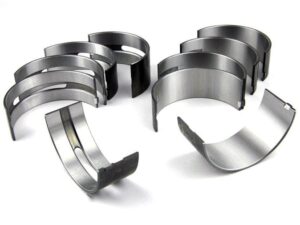
Alloy 850.0 – Example of Cast Aluminum Alloys
Alloy 850.0 (A08500) is a cast aluminum alloy characterized by the presence of tin (~6%), which provides inherent lubricating properties while maintaining good resistance to pressure and fatigue.
It is widely used in:
- Cast bearings for heavy-duty engines
- Marine components due to corrosion resistance and excellent machinability
- Diesel connecting rod bearings and parts requiring high dimensional accuracy and heavy load capacity
Advantages of Aluminum Bearings
- Lower weight compared to bronze and babbitt bearings
- Higher load-carrying and thermal resistance
- Proper machining and shaping
- Corrosion and wear resistance